Decay (Pre-) Processing
A number of operations and processing options can be applied to ROI decays, either as they are being extracted from a dataset (in that case, the decay is “pre-processed”), or after they have been displayed in the Decay Graph (in which case, the decay is merely “processed”).
There are more functions applicable to decays plotted in the Decay Graph than
available to decays calculated from the raw data (which happens, for instance,
when using the Analysis:FLI Dataset:Current ROI Analysis menu item). These
functions are described in the Fluorescence Decay Panel page
of the manual.
Available operations and associated options are set in the Fluorescence Decay:Decay Pre-Processing panel of the Settings window.
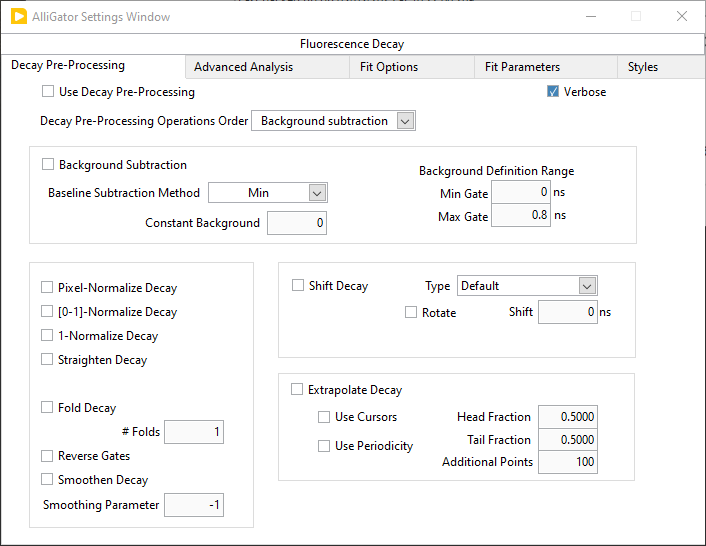
These options are applied to newly computed decays only if the top left
Use Decay Pre-Processing checkbox is checked. These pre-processing operations
can also be applied one at a time to existing decays using the right-click menu
(Process Plot(s)) in the Decay Graph. In that case, the Use Decay
Pre-Processing checkbox does not need to be checked off.
The order of the decay pre-processing operations applied to newly computed decays is user-selectable. For instance, in the case of photobleaching or photobrightening, this allows correcting for that effect before attempting a square-gated single-exponential background subtraction.
To change the order of operations, right-click on the Operations Order list and select Reorder Operations: this will open a window showing the current list order:
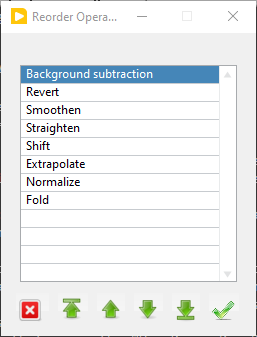
Selecting any of the items, use the buttons at the bottom to change the order of that item in the list. When done, click the OK button (rightmost button) to accept and close the window, or the Cancel button (leftmost button) to cancel any modifications to the original list. Closing the window is equivalent to cancelling and accepting that choice.
The following is a description of the different operations in the order they appear in the Settings:Fluorescence Decay:Decay Pre-Processing panel.
Background Subtraction
There are 4 different methods (not including background file subtraction) to
define the value to subtract from each decay point. They are listed in the
Baseline Subtraction Method pull-down list as: Mean, Min, Square
Gated Single Explonential and Constant.
1. Mean or Min Baseline
It is customary in time-gated imaging experiments to offset the decay on the time axis in such a way that a flat (background) zone precedes the actual rise and decay. This trailing” part of the decay can therefore be used to estimate the background for each ROI (and by extension, for each pixel). The user needs to define the Min Gate and Max Gate locations to be used for background estimation. The actual value retained as background is the minimum (Min) or average (Mean) value recorded in this gate interval.
2. Square Gated Single-Exponential method
In this approach (Square Gated Single-Exponential), the recorded decay is assumed to be the result of a single-exponential decay integrated over a square gate of duration W (See description in ref. 2 in the Bibliography page). The user needs to provide the gate positions where the known minimum (Min Gate) and maximum (Max Gate) of the decay are observed (best obtained by looking them up on a reference decay with high SNR). The analysis computes the Baseline value (which will be used for background subtraction), Amplitude and Lifetime associated with the decay and displays them on the top right of the Fluorescence Decay panel. These parameters as well as the total integrated intensity are associated with the decay and the corresponding phasor plot data point (Phasor Graph panel).
3. Constant Background
It is possible to provide a user-specified background value to subtract from
decays using the Constant option of the Baseline Subtraction Method and
entering the desired background value in the Constant Background control.
Decay Normalization
Decays can be normalized to a maximum value of 1 (by dividing by the maximum value), or mapped to the [0, 1] interval (by subtracting the minimum and dividing by the decay range), by checking the 1-Normalize Decay checkbox or the [0, 1] Normalize Decay one.
Alternatively, the decay can be divided by the number of pixels comprising the source ROI by checking the Pixel Normalize Decay.
Decay Straightening
Occasionally, samples can photobleach (or photobrighten) during the course of a series of gate acquisition. This phenomenon is identifiable by the fact that the recorded gate value at the end of a complete laser period is different (generally smaller but sometimes larger) than at the beginning of the period. The straighten function assumes that this is due to an exponential decay (or increase) of the signal due to some underlying phenomenon, and attempts to calculate the time scale of this variation as well as its amplitude, and finally, correct for it accordingly throughout the gate sequence. Up until version 0.18.1, this correction was applied as follows:

where \(F_{min}\) is the minimum decay value, T is the period, \(\tau\) is the photobleaching/photobrightening time constant obtained from:

The sign of \(\tau\) obtained from the above equation handles both cases. After version 0.18.2, the correction does not consider that the decay consists of a constant background \(F_{min }\) added to a photobleaching/photobrightening component, as this background component should be taken care of by the background subtraction step, which usually precedes (*) all other pre-processing steps. As a consequence, the formula becomes:

where \(\tau\) is given by:
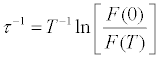
This equation requires that F(0) and F(T) be non-zero and if no photobleaching/photobrightening occured, identical. In other words, the decay needs to be shifted such that the maximum of the decay is the first gate, and the last gate corresponds to the same location in the decay (it will therefore not work with a truncated decay, and in fact will require an extra gate beyond the laser period).
(*) Note that since version 0.19, it is possible to change the order of the different decay pre-processing operations (except pile-up correction, which remains the first operation). This means that if background correction follows decay straightening, the assumption of the straightening algorithm may be incorrect (i.e. the algorithm will assume that both decay and background exponentially increase or decrease with the same time constant).
Decay Folding
Decay folding consists in dividing the decay in an integer number n of equal segments and summing them up to form a decay n times shorter. The segments’ length should obviously be equal to a multiple of the laser period for this to have a physical sense.
Gate Reversing
When selected it, changes the direction of the plotted decay.
Decay Smoothing
Occasionally, a decay may be affected by undesirable “spikes”. It is sometimes possible to remove those spikes using cubic basic spline smoothing (details can be found at http://zone.ni.com/reference/en-XX/help/371361P-01/gmath/cubic_spline_fit/). The Cubic Spline Fit implementation of LabVIEW is used without weights, and smoothness parameters identically equal to 1 for all points, and balance parameter equal to 1 -10^(-x), where x is the Smoothing Parameter defined in the Settings:Fluorescence Decay:Decay Pre-Processing panel. From the Cubic Spline Fit description page linked to above:
If x = 0, the cubic spline fit is equivalent to a linear fit. If x = Inf, the cubic spline fit interpolates between the data points.
If x < 0, an appropriate value is automatically calculated according to the time axis values.
To use this algorithm as part of the decay pre-processing, check the Smoothen
Decay checkbox. The only exposed parameter for this algorithm is Smoothing
Parameter.
Alternatively, an existing decay can be post-processed (creating a new plot)
using the Process Plot(s):Smoothing Decay Graph right-click menu (see below).
Decay Shifting
Decays can occasionally “shift” along the time axis due to several possible causes (in general, setup instabilities). While this is normally not causing problems if data is properly calibrated, it is possible to force alignment of all decays along the time axis by checking the Shift Decay checkbox. There are several options associated with this functionality.
Type: this drop-down list gives access to 4 modes described below:
Rotate: this checkbox specifies whether the shift results in a rotation of the decay (considered periodic) or whether to pad the decay with zeros and discard points corresponding to negative abscissa.
Shift: this parameter has different interpretation depending on the type of shift selected (see below for details) and is not always visible.
Threshold: this parameter is used in the Threshold mode only (see below for details).
Decay shift types details
Default: in this case, a constant shift is applied to all decays. This can for instance be useful to align the peak of a given sample to the zero point, or align decays acquired with different setups, etc.
CFD: the constant fraction discrimination mode applies a constant shift to each decay before inverting it (multiplying it by -1) and adding it to the original decay. The effect of this operation, provided the shift is of the order of the IRF width or smaller, is to create a curve looking like a “chirp”, with a positive bump followed by a negative one, with a zero point in between. This point is generally stable if the shape of the decay is relatively constant (the amplitude can vary). The position of the zero-crossing point is then compared to that of the stored Reference Decay and the difference between these two positions is defined as the decay shift.
Threshold: in this mode, the provided Threshold parameter is used to find the first location in the decay where this threshold is crossed (from below). This location is compared to that obtained for the store Reference Decay and the difference between these two positions is defined as the decay shift.
Cross-Correlation: in this mode, the cross-corelation of the decay and the stored Reference Decay is computed and the position of its maximum determined and returned as the decay shift.
At the end of a series of decay analysis, it is possible to plot the calculated
shifts in the Lifetime & Other Parameters Graph of the Lifetime & Other
Parameters panel, using the Plot Decay Shifts context menu item in that
graph.
Decay Extrapolation
In case the decay tail doesn’t reach the background level, the resulting phasor will be offset by an amount that will depend on the final value reached by the decay. It is possible to compensate artificially for this truncation by extrapolating the decay with an exponential tail.
Likewise, if the IRF used for NLSF analysis for reconvolution with the decay model is truncated, the computed convolution product may differ significantly from the true convolution product. IRF extrapolation may help improve the results.
The parameters defining the range of the extrapolation are defined in Settings:Fluorescence Decay:Decay Pre-Processing under the Extrapolate Decay checkbox.
Use Cursors: this checkbox allows choosing between using cursor locations or fractional values to define the Tail and Head start and end locations. Two cursors need to be created in the Decay Graph using the
Process Plot(s):Extrapolation:Create Head & Tail Bounding Cursorsmenu item. Their locations can be stored in the two Head Fraction and Tail Fraction controls in the Settings:Fluorescence Decay:Decay Pre-processing panel by using theProcess Plot(s):Extrapolation:Store Cusor-define Head & Tail Fractionsmeun item of the Decay Graph.Head Fraction: defines what fraction of the decay (starting from the beginning) is used to perform a fit to a single exponential decay. This part of the decay will be shifted to the end (either past the requestd additional points or past the laser period, see below).
Tail Fraction:specifies what fraction of the decay (starting from the end) is used to perform a fit to a single exponential decay.
Additional Points parameter specifies how many points (spaced as in the original decay) to add to the decay.
Use Periodicity: instead of requesting a number of points to be added to the decay, one can ask for enough points to be added to reach the end of laser period by checking this box.